• About
    • Educational Philosophy
    • Research
  • Courses
    • Study Tips
    • Digital and Scientific Literacy (Let’s Talk Science)
    • Science 9
    • Wellness 10
    • Financial Literacy 10
    • Mental Health Studies 20
    • Environmental Science 20
      • Nature of Environmental Science
      • Atmospheric Systems: Air Quality and Climate Change
      • Human Population
      • Aquatic Systems
      • Terrestrial Ecosystems
    • Gaming Education
      • RPG Maker 2000
    • Gender and Sexual Diversity 20
      • Deepening the Discussion Toolkit – Ministry of Education SK
      • NFB – Sexual Orientation and Gender Identity Media
    • Health Science 20
      • Nutrition
      • Human Body
      • Diagnostics and Treatment
      • Health Care Philosophies and Ethics
      • Career Exploration (HS20-CE1)
    • Biology 30
      • Characteristics of Life and Evolution
      • Anatomy and Physiology of Multicellular Organisms
      • Cell Processes
      • Genetics and Chromosomes
    • Science 10
    • Math
    • AP® Biology
      • Course Outline and Introduction Assignment
      • AP Biology Exam Prep
      • Big Idea 1: Evolution
      • Big Idea 2: Biological Systems and Energy
        • Energy-Related Pathways
      • Big Idea 3: Information Storage and Transfer
      • Big Idea 4: Biological Interactions
      • Blog Post Information
  • Podcasts
    • Learning Together – A Prairie South Podcast
    • Let’s Talk Science Podcast Collection
    • A Moment of Entangled Truth: A Science Education Podcast
  • Presentations
  • Education Blog
    • Science Education
      • One of an Infinite Means to Approach Science, Education, and the Universe: Part 1 – Nature of Science
      • One of an Infinite Means to Approach Science, Education, and the Universe: Part 2 – Objectivity, Subjectivity, and Perspective
      • One of an Infinite Means to Approach Science, Education, and the Universe: Part 3 – Life & Kinship
      • One of an Infinite Means to Approach Science, Education, and the Universe: Part 4 – Science Education
      • Developing a high school science digital citizenship resource
      • Maximizing Education for Digital Literacy
      • Scientific Literacy and Digital Citizenship Lessons
      • Digital Literacy in Saskatchewan Science: A Curriculum Guide
    • ECI 832 – Digital Citizenship & Literacy
      • Maximizing Education for Digital Literacy
      • Digital Learners and Digital Wisdom in a Digital World
      • Transgenerational (Digital) Citizenship Education
      • Developing a high school science digital citizenship resource
      • Digital Identity: Past, Present, Future
      • The Need for Media Literacy
      • Can we ever be “fully literate” in all dimensions of literacy?
      • My critical, digital life.
      • A Media Literate Rhapsody
    • ECI 834 – Distance Education
      • Closing the distance between distance education and myself.
      • (re)Creating a virtual educator.
      • LMS or VLE? Don’t matter to me! Canvas? Let’s see.
      • Can an educator become YouTube famous? Creating, comparing and critiquing an educational Vlog.
      • Blended learner = blended educator.
      • Barriers to blended/hybrid/mixed-mode/distributed learning.
      • Online community-buildin’ probs (problems).
      • Agoraphobia in education.
      • Module-making: finishing touches to going worldwide.
      • Teaching for EVERYBODY.
    • ECI 833 – Educational Technology
      • Can’t fight the #EdTech juggernaut.
      • Learning as a chaotic, evolving mosaic.
      • The digital life of a teacher-entertainer.
      • Educational software is changing for us, and us for it.
      • Stop villainizing the internet.
      • Distance education: bringing the Mr. Petlak Classroom Experience Worldwide?
      • Determining pros and cons myself of modern internet learning as self-determination.
      • I’m not secretive, I’m Socrative; Assessing Assessment Tools.
      • Assistive technology knows no bounds!
      • A whole new world: virtual and augmented reality.
      • Ed Tech is/has always been about us and our learners.
    • ECI 831 – Social Media and Open Education
      • ECI 831 – Major Project – Piano
        • Synthesia and Pre-Assessing My Piano Skills
        • Let the chords be with you.
        • Piano: Don’t cut (chord) corners.
        • Learnin’ piano on the go, bro!
        • Revelations: feedback and music/language learning
        • Piano injuries: movement retraining.
        • Learning piano: Patience, hard work and connections that transcend time.
      • How I overcame #edtech anxiety.
      • Being a devil’s advocate teacher.
      • I M Connected. R U? U R?! GR8.
      • “You’re born a teacher”. Making teaching a science?
      • When your teacher Snapchats in class.
      • Why do Students Snapchat? Intimacy and Connectedness.
      • Harnessing social media: anonymity and digital citizenship
      • Fundamental rights of open education.
      • Looking at the digital educator narrative, wearing Googles.
      • Net neutrality, safety in ambiguity, equity, and a digital(ly) divide(y).
      • Normalcy and “justifying” online harassment
      • Sharing an idea: the perks of Slacktivism
      • ED Goals: Continue to connect, learn, question and improve.
    • ECI 830 – Issues in EdTech
      • Defining what exactly #EdTech is.
      • EdTech in class doesn’t just enhance learning, it IS learning.
      • Just Google it? Just Google it right. Building from simple to complex.
      • Games, technology and student learning and well-being
      • Sharing and openness. A moral imperative, even on social media.
      • Social media IS childhood.
      • Good intentions and what is morally just make EdTech equitable.
      • Should you sell your educating soul for the right reason (students)?
      • Dialled in, plugged in, and loving life.
      • Educate and you will be gold.
  • Health Ed Resources
    • Be There Certificate
    • Mental Health Literacy (TeenMentalHealth)
    • Canadian Guidelines for Sexual Health Education
    • Deepening the Discussion: Gender and Sexual Diversity
    • Teaching Sexual Health
      • Teaching Sexuality Wheel
    • Sex & U
      • Sex & U – Contraception Methods Booklet
    • Planned Parenthood
  • EdTech: Resources & Tools
    • General Resources
      • Google Read&Write
      • Flocabulary
      • Super Teacher Worksheets
    • Assessment Tools
      • Kahoot!
      • Seesaw
    • Science & Math Resources
      • Let’s Talk Science
      • Nutrients for Life
      • Zorbits Math
      • Teach Engineering: STEM Science Lessons
      • Prodigy – Math Game
      • Math Tasks for Sask Curriculum (AirTable)
      • MathUp
      • Secondary Science Implementation Support – Resources
      • Gizmos – Science & Math Simulations – Subscription Required
      • BioInteractive – Science Activities
      • PhET – Interactive Science Simulations
      • Desmos
      • Science Current Events Sites
        • Science News for Students
        • IFLScience
        • EurekAlert!
    • Teaching Typing
      • Typing.com
      • Typing Club
    • Coding
      • SaskCode
      • CodinGame
      • CS First
      • Scratch
      • Code Combat
    • Digital Citizenship
      • Digital Citizenship Education in Saskatchewan Schools
      • TeachThought
      • Crash Course Navigating Digital Information
      • Common Sense Education
      • Media Smarts
      • Web Literacy for Student Fact-Checkers
      • Interland – A Digital Citizenship Game
    • Open Education
      • OER Commons
      • Open Stax
      • Open Textbook Library
      • Open Text BC
      • EdX: Free Open Online Courses
      • Coursera

Logan Petlak

~ Lifelong Learner.

Logan Petlak

Tag Archives: education technology

Learning as a chaotic, evolving mosaic.

04 Tuesday Oct 2016

Posted by loganpetlak in ECI 833

≈ 3 Comments

Tags

biology, connectivism, constructivism, Dewey, ECI 833, eci833, edtech, education technology, evolution, learning theories, learning theory, teacher

Which learning theory is right?
learning

“learning” via BlueDiamondGallery

Ashley Murray nailed it: “As teachers I think that it’s important that we avoid getting caught up in which theory is the BEST theory to use.”

Taking a page out of John Dewey‘s playbook, I feel the need to ‘link sciences’. What is my take on learning theory?  Learning as a chaotic, evolving mosaic. I use mosaic in the biological sense, when separate genetics are present together. Substitute genetics for learning theories, and away we go.

Much like evolution as a “theory”, they don’t become theory without reputable and verifiable strategies, experiments, and support. Since so many streams of learning theory hold weight, combining them and treating learning as an evolving and changing process. Let’s allow learning to proceed as a complex science including constructivism, behaviourism, cognitivism, and every other learning theory.

Ultimately, as educators, when we consider our philosophies it comes down to the first two questions Schunk (Learning theories: an educational perspective, 1991) asked:

  1. How does learning occur?
  2. What factors influence learning?

Learning occurs through connecting with others who may have different ideas and perspectives than us, through the chaos of diversity. We associate and establish similarities and differences between what we know and seek to learn. We conceptualize and translate texts, tones, and visuals. Everything we learn, builds to the next lesson. Every experience we’ve had, problems we solve, memories we retain, every innate ability and predisposition we have influences how we learn. Reinforcement and punishment influence our perception of how we view it, but even that knowledge and learning is organic and evolves as we reflect. We independently yet dependently learn holistically (physically, socio-emotionally, mentally) and it manifests itself in our society as a mosaic. This particular quote resonated with me and diversity and complexity of learning: “Which theory [or theories] is the most effective in fostering mastery of specific tasks by specific learners?” Adjust and adapt. To lock yourself into one belief of learning theory and deny others seems counter-intuitive, or think it is something clean and linear (like a pyramid). Humanity learns.

Ideally, that’s what my classroom would look like. Does it look like that every day? Maybe not upon initial viewing, but it’s rooted in what I do. And it’s constantly changing.

you-gone-learn-today

via Giphy

Do you agree that learning is hard to classify? It’s worth looking at all the different beliefs on learning. Some may have more evidence than others, but as a connectivist would tell you, even the opinions we don’t agree with have relevance and meaning to learning.

– Logan Petlak, lifelong learner.

Dialled in, plugged in, and loving life.

23 Thursday Jun 2016

Posted by loganpetlak in ECI 830

≈ 3 Comments

Tags

augmented reality, coldplay, ECI 830, eci830, edtech, education, education technology, fear of missing out, loneliness, look up, PLN, plug in, teacher, unplug

“Look up“.

Great advice for some, but not all. I think in some cases, we need to try to reflect on the value of looking down… and what looking down allows us to do – connect, answer, and learn. Yes, we can go to a concert and hear musicians tell us to unplug and live in the moment, and we need to, but what about getting a video of Chris Martin singing “Fix You” for your friend who couldn’t be there because they were sick?

Some moments don’t need a camera; there is value in appreciating things without a digital record… But, like every other debate we’ve had, we need balance, moderation, and an open mind. Is taking a video of a child’s first steps also “not living in the moment”? Or is it an opportunity to reflect and relive the moment many years later? Humanity is evolving, constantly rewiring the hardware of our brains, and with this includes modern connectedness and socialization, which occurs by looking down and utilizing our technology and devices. We are comfortable with looking down when it helps us learn with PLNs or to help facilitate learning and friendships, but are quick to antagonize it when people don’t appreciate moments the way we might want them to. There is a challenge to begin to recognize that who we are today involves a link between offline to online life. This is echoed by the concept of augmented reality. As we learn about what our digital footprints are, and adjust our digital identity to improve this, we improve our IRL identity as a result… we project a better us to live up to. (But this can create pressure to please, so we need to continue to reflect and be fair to ourselves).
Optimism versus the facts against being plugged in.

“Plugging in” has been called “a way to avoid dealing with loneliness“,

Loneliness_(4101974109)

Loneliness via Wikimedia Commons

but perhaps it is an opportunity to decrease boredom. Loneliness and boredom encapsulate two states of mind that are, at times, difficult to differentiate from one another. I would seek to argue that perhaps we are more engaged and stimulated than ever before, but is there a backlash to this? What is it? We are all capable of multi-tasking better than ever before, yet some evidence points to the idea that I am wrong, and simply have less attenton and focus. Having too much going on at once is imposed by tech and causes higher levels of stress… including how connected we are and the inherent expectations for shorter response times. Contrary to this, I would argue that I feel efficient when I get a lot done in a day, and am capable of getting a lot of things done thanks to technology, and have a lot of positive means of coping with the potential stress that occurs as a result. I want to be involved and I feel fulfilled when I am… or am I just afraid of missing out?

Fear of missing out is a reality for some, and some may tell you that technology is making this worse, but there is also learning to be had when struggling with this fear. Speaking from personal experience, through toddler to teenager, I have been completely wrapped up in what others are doing, and over time learned to accept the things I may be missing out on for what is more important, isn’t that what growing up is and has been for some time? Some argue that technology can be an addiction, observing others who make trips home to retrieve devices that, without them, said individuals would feel naked. I have a hard time agreeing that technology is an addiction, we have it to connect and it is something that we feel improves or is needed in our lives. How is this different than applying the argument to being addicted to our cars or other modes of transportation? It is a part of our lives that improves our lives, and the fact that I feel that I “need” it to get to work wouldn’t be considered addiction or “bordering on obsession”, so many things would therefore border on obsession. My love of hockey, teaching, cats, and my family, borders on obsession. However, the points listed above make my life better, no question about it. Does being plugged in actually make my life better?

Does being plugged in legitimately make your life better?

Does being plugged in make your students’ lives better?

If you think it doesn’t, then stay unplugged.

For me?

I am dialled in.

I am plugged in.

I am educate-in.

And I am loving life.


EC&I 830, have a great summer.

Logan Petlak


Sharing and openness. A moral imperative, even on social media.

02 Thursday Jun 2016

Posted by loganpetlak in ECI 830

≈ 3 Comments

Tags

digital citizenship, edtech, education technology, morality, morals, openness, rachel botsman, sharing, social media, social pressures

Sharing is a moral imperative.

This week we debated the necessity or disservice of sharing and openness in schools in the context of social media and education technology. And, much like many of our discussions, it involves statements or hesitations from some that we could apply to other arguments about childhood and life. Observing my opening sentence, read the italicized and consider if that phrase, not in the context of social media, but rather of students of the past. Is or was sharing and openness not encouraged, with emphasis on competition instead? Perhaps not in schools, but at home?  Once upon a time, ‘openness’ and sharing emotions was discouraged as part of social pressures on males (The Mask You Live In). But in today’s world, openness and sharing is a given, a moral imperative. And sharing and openness in social media is no exception to this fundamental moral imperative. But sharing is a learning process, parents and educators need to learn themselves and guide students through the process of now understanding sharing not just in the historic sense of “Billy, let Tim play with your toys too”,

Children_sharing_a_milkshake

Children sharing… via Wikimedia Commons

it’s become “Billy, don’t feel like you need to let Tim know about every single thing you’re doing today on Instagram”. We can share learning, or perhaps important life events, but where is the line in what we should share? Juan Enriquez presents the idea that everything we share leaves that digital tattoo. So, while I would argue we need to share, we need to be aware of the implications of what we share about ourselves and others. Much like presenting ourselves professionally in public, like at a social gathering, today social media is where humans gather and “humans are wired to share”. Rachel Botsman, makes this argument in her case for collaborative consumption.
https://embed-ssl.ted.com/talks/rachel_botsman_the_case_for_collaborative_consumption.html


Learning about sharing. How do we share better?

There are a lot of reminders out there about why we need to be aware of our digital footprint. Sometimes there is that fear about what we put into the big scary internet, but we (teachers and students) can use it to our advantage. This requires some learning to take place. In discussion with my grade nines, we stumbled onto an apparent digital citizenship learning curve. In many ways, as student’s raised in the social media age, they hit certain milestones or realizations about what is “okay” online far sooner than I ever did. Like any bit of learning, however, there are gaps. Some learn to avoid “oversharing” younger, yet fail to understand the idea of creating a positive digital footprint and post profanity or inappropriate content. As a young educator, I am fortunate to have been raised in the beginning of the social media age, but learned through mistakes and failure; different generations have different exposure and opportunity. So, rather than a trial by fire, or through personal experience depending on the generation of teachers, educators need a guideline for teaching digital citizenship in our school, thanks Alec and Katia. Find your line and use the resources to teach about openness and sharing through social media responsibly.

Where is the ideal line between sharing too much and not enough though? We can be aware of our digital footprints, but one person’s definition of a good digital footprint may be slightly different than another, much like one individual’s thoughts on sharing may be different than another. Where is your line?

Logan Petlak

EdTech in class doesn’t just enhance learning, it IS learning.

24 Tuesday May 2016

Posted by loganpetlak in ECI 830

≈ 3 Comments

Tags

adaptations, circle of courage, ECI 830, eci830, edtech, education technology, learning, modified, social media, student advocacy, teacher, technology in the classroom

Someone once said to me (yes, “said”, this definitely isn’t an assigned question I read), “Technology in the classroom enhances learning”. My first thought was, “yes, of course it is, it’s silly to think otherwise…”


petlak couros special.JPG

“Logan Petlak reflecting” via Camera of Samsung Galaxy S5

Then I reflected on it a bit…


…

..

.

.

..

…

nothing changed.

Statement still is accurate.

Why do I think that?

Well, I would argue that technology in the classroom today is learning. Regardless of the mechanisms students use to grasp the content embedded in our curriculum, technology plays a role one way or another. Be it delivering the students to educational institutions, how they get their nutrition for the day, or utilizing apps, programs, and devices to foster learning. Don’t get me wrong, there are problems within its use and a need for doubt, as Greg Toppo reminds us about humanity’s tendencies, “we always fret about technology”. We need the doubt to continue to grow and check ourselves, but we can’t deny the importance of technology and the learning inherent within.

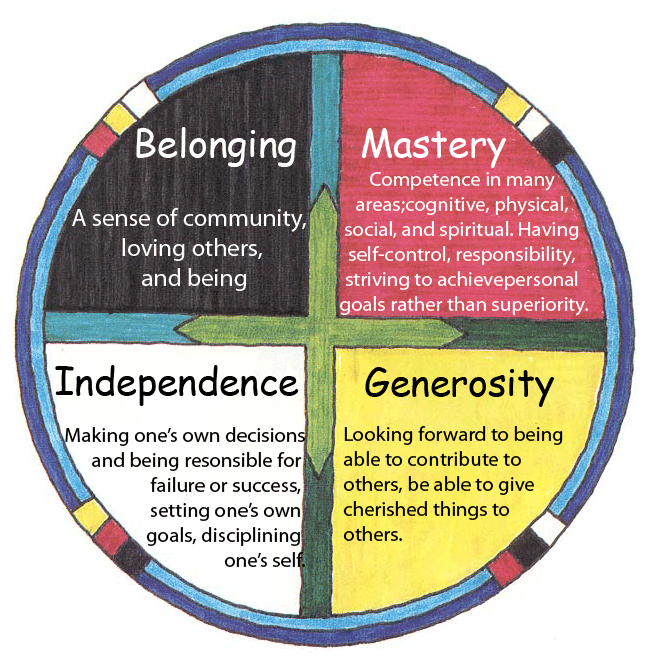
The learning extends beyond simply curricular content. Technology is a force for connectedness in the modern world. When considering the circle of courage below, I could connect it to each of the dimensions of it connecting to Digital Citizenship. Belonging through social media, independence through responsible device use, generosity with commenting and sharing with others, and mastery in the procurement of curricular knowledge and outcomes.

CofCLabeled

Circle of Courage via BehaviorAdvisor.com

“using technology promotes sense of belonging and interactive participation in the classrooms for children with learning disabilities”  – Bryant and Bryant, 1998

The above quote speaks to me as a student advocate and reinforces the connection to the circle of courage. Developing that sense of belonging is consistent with it and is a critical part of development for all youth. And this belonging occurs in technology in the form of social media today.


Devil’s advocate: For the doubters.

Now I know there may be student advocates or doubters thinking… “But Logan, what about the students who are in the classroom who don’t have access to phones in BYOD (bring your own device) settings?” Fine. Devil’s advocate? Yes, some students will not have devices and this raises questions of further increasing the wealth and technology gap in the classroom. And yes, BYOD can exacerbate that, but in province-wide school divisions facing cutbacks or lean spending models being approached, can it afford purchasing devices for all, probably not, but some, be it through donation or purchase for need in the classroom. We are obligated as educators to keep students educationally literate and up to speed on current learning (technology, by extension), and we can minimize education spending whilst teaching students to use their own tools or hand-me-downs from another to stay connect an learn. If anything, the arguments against BYOD enforces the importance of devices in the classroom, the students need to at least learn about it here if not at home. Fact: Inequity will always be present between student in our schools… so as educators, rather than blanket money spending for every single student, follow the example of modified, adaptation and differentiated instruction and simply provide necessary tools to those that need it, and adjust instruction accordingly. And this doesn’t even consider the adaptations with technology, as Justine puts it, “all of the different technology can lead to equity for students in the classroom.”

But, Logan, what about ___________________”.

“The need more PD (professional development) for using EdTech” – “Most teachers want to learn to use educational technology effectively, but they lack the conceptual framework, time, computer access and support necessary to do so”. I have a hard time agreeing with this. Arguments can be made both ways, but for me, my biggest point of contention is “time”. One of the benefits of technology in terms of knowledge acquisition is that it takes less time looking online than travelling to a library or accessing a textbook. Maybe the information on how to use it isn’t there, however, so logic would denote there should be professional development for this. Interesting idea, but at what cost? And what aspect of technology do you target? Phones? Apps? Computers? Programs? Existing PD on working with language learners may utilize this technology anyway (if not, plan accordingly). Not to mention, if EdTech PD isn’t a perceived need in the entire division, is it worth making a specific priority? If most PD’s themselves incorporate tech, then this should happen unconsciously and simultaneously and not require increased spending (in tight budgets, as referenced before).

“Technology reducing performance” – Comparing “performance” in the critique of the use of technology, and what I fail to see is the assessment means… is it consistent with the circumstances in which learning took place? Same content, different written/technological delivery, same written assessment? I have a hard time seeing an immediate correlation without explicit details on the assessment means.


Final thoughts

As I said, we need doubts about what technology involves. But the fact is that learning and working today requires technology, and to ignore that or avoid it as an educator does a disservice to our students… especially if they come from a device-free background.

What are your thoughts? New technology can have new detriments or roadblocks to learning? But is it just the struggles of our times? Comment!

– Logan Petlak


Defining what exactly #EdTech is.

13 Friday May 2016

Posted by loganpetlak in ECI 830

≈ 4 Comments

Tags

ECI 830, eci830, edtech, education technology, social, social studies, technology

Google “Education Technology“. What you find is a definition from Wikipedia of  “Education Technology“:

“the study and ethical practice of facilitating learning and improving performance by creating, using, and managing appropriate technological processes and resources.”
Association for Educational Communications and Technology via Wikipedia.

As an individual exposed to the ideas of Education Technology (henceforth referred to as #edtech) this all makes sense… and, happily, it has the best interests of student learning in mind. But what about the definition of technology? Often we approach technology through the lens of computers and gadgets, but may not recognize the ideas and processes associated with #edtech. Case in point, upon finding an appropriate technology-related image, the picture below was the closest one to being accurate, but still rampant with electronic devices.

technology-662833_960_720

“Technology” from Google Images via Pixabay

To the left you see an iPod, TV, Camera, and some sort of electric hair clippers close to the nose… your stereotypical forms of technology.

What am I getting at?

Technology is so much deeper than we give it credit for. We assume it is simply a network of electronic connections and the concept of “technology”. It isn’t. Knowing a book can be used as a paperweight, or that Fonzie-style hitting the copier will fix it, that is technology. Further applying it to education, it considers adaptions and differentiation for students without an app or tablet. It has shaped history, not just in the creation of new weapons or medications, but also in ideas, beliefs and algorithms.

We make this separation with students, and this discussion is actually present in the Saskatchewan Social 9 curriculum! I tweeted about it one day when my students and I discussed it! But do we always remember it as adults and educators?

Social 9 talked about how technology is more than just a phone. It can be a process or idea. How does this relate to #edtech? #eci830

— Logan Petlak (@MrLPetlak) May 11, 2016

I hope to remind myself over the course of #eci830 the widespread implications of EdTech. And that the inherent discussions and debates within also represent educational technologies through the sharing and creation of ideas.

Honing in on our original definition of EdTech. I also know that EdTech does involve a variety of apps, programs and resources that enhance student learning and I’m extremely excited to continue to utilize them.

Thoughts? Comments? Questions?

Erin Benjamin shared the excitement of getting into this class in her blog, and I agree. She mentions connecting with colleagues and learning with others… I guess that’s nice too…

I’m Logan Petlak by the way.

Find out more about me here!

Logan Petlak

Follow Logan Petlak on WordPress.com

Contact Info

109 Ominica St W
Moose Jaw, SK
Treaty 4 territory
petlak.logan@prairiesouth.ca (for students); logan.j.petlak@gmail.com (for general inquiries)
Regular school hours!

Meta

  • Create account
  • Log in
  • Entries feed
  • Comments feed
  • WordPress.com

Categories

What are you looking for?

Create a free website or blog at WordPress.com.

Privacy & Cookies: This site uses cookies. By continuing to use this website, you agree to their use.
To find out more, including how to control cookies, see here: Cookie Policy
  • Subscribe Subscribed
    • Logan Petlak
    • Join 42 other subscribers
    • Already have a WordPress.com account? Log in now.
    • Logan Petlak
    • Subscribe Subscribed
    • Sign up
    • Log in
    • Report this content
    • View site in Reader
    • Manage subscriptions
    • Collapse this bar
 

Loading Comments...